
Quick Answer: A crown is a custom cap that covers and protects one damaged tooth you still have. A bridge replaces one or more missing teeth by joining a false tooth to crowns on the healthy teeth on either side. So the choice usually comes down to one question: is the tooth still there and worth saving, or is it already gone?
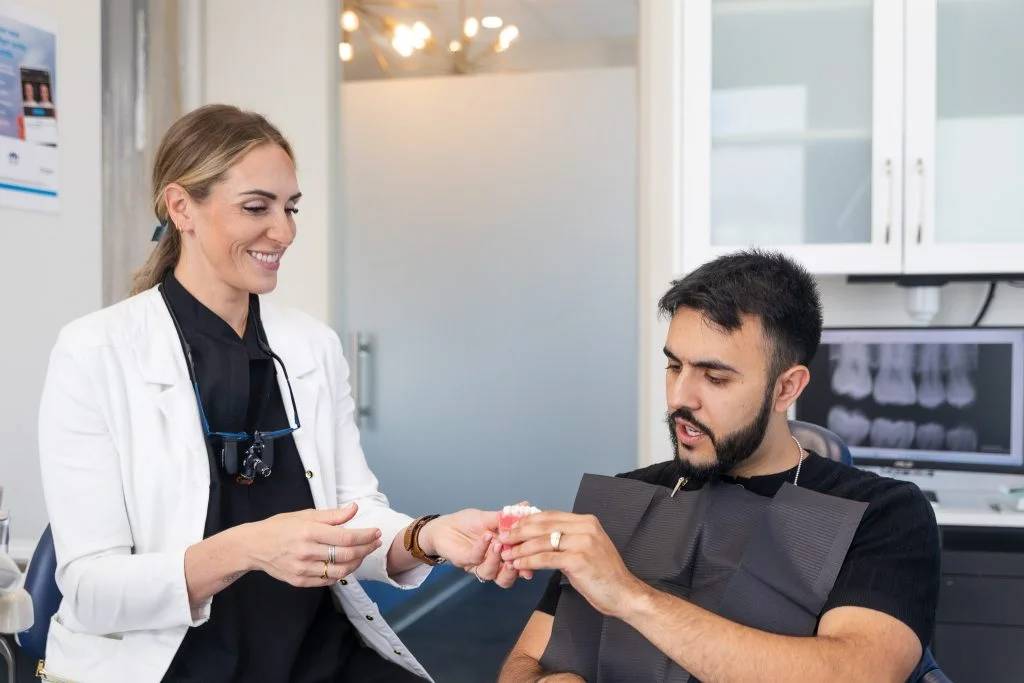
Many patients use the words “crown” and “bridge” as if they mean the same thing. In fact, they solve two different problems. If you are weighing crowns and bridges in Strathroy, it helps to understand what each one does before you sit down in the chair. At Burns Family Dental on Burns Street, our dentists often explain the difference with a quick sketch. The sketch shows a crown protecting a tooth and a bridge filling a gap. This guide walks through the same explanation, so you can arrive at your appointment already knowing the right questions to ask.
What Is a Dental Crown?
A dental crown is a tooth-shaped cover that fits over your own tooth, right down to the gumline. It restores the tooth’s shape, strength and appearance. According to the Canadian Dental Association, dentists use crowns for teeth that are broken, badly decayed or weakened by large fillings. A crown also commonly protects a tooth after root canal treatment.
The important detail is that a crown needs a natural tooth root underneath it. In other words, your dentist is rebuilding something you still have. Specifically, the dentist shapes the tooth, takes an impression, and places a temporary crown. Afterward, the permanent crown is bonded in place at a second visit.
Signs a crown may be the right fit
You may be a good candidate for a crown if a tooth has cracked, if a filling has grown too large to hold, or if the tooth looks worn or discoloured. Similarly, back teeth that have had root canal therapy often need a crown because they become more brittle over time.
What Is a Dental Bridge?
A dental bridge replaces a missing tooth by “bridging” the gap with an artificial tooth. That false tooth, called a pontic, attaches to crowns placed on the teeth on either side. As the Canadian Dental Association explains, those neighbouring teeth act as anchors for the whole unit.
This means a bridge actually contains crowns. However, its purpose is different. A crown saves a tooth, while a bridge stands in for one that has been lost to decay, injury or extraction. Furthermore, a bridge is fixed in place, so you do not remove it at night the way you would a partial denture.
Why filling the gap matters
An empty space rarely stays empty for long. Consequently, nearby teeth can drift or tip into the gap, and the opposing tooth can drop down. Over time, this shifting can change your bite and make cleaning harder. A bridge holds everything in position.
Crowns and Bridges in Strathroy: A Side-by-Side Comparison
The simplest way to compare dental crowns and bridges is to look at the problem each one solves. Here is how they line up:
- Purpose: A crown repairs a damaged tooth. A bridge replaces a missing tooth.
- Teeth involved: A crown usually affects one tooth. A traditional bridge involves at least three units: two anchor crowns and one false tooth.
- Effect on nearby teeth: A crown changes only the treated tooth. A bridge requires reshaping the healthy anchor teeth.
- Cleaning: You brush and floss a crown like a normal tooth. A bridge needs a floss threader or small brush under the false tooth.
Both restorations rely on healthy gums. Indeed, a 2022 narrative review in the Journal of Functional Biomaterials noted that periodontal health plays an important role in the longevity of fixed prosthetic restorations. For that reason, our team checks your gums carefully before recommending either option.
Which One Do You Need?
You likely need a crown if the tooth is still present and its root is healthy. On the other hand, you likely need a bridge if the tooth is missing and the teeth beside the gap are strong enough to support it.
Real cases are not always that tidy, though. Sometimes a tooth is so badly damaged that saving it with a crown is not realistic. In that situation, your dentist may suggest an extraction followed by a replacement. Likewise, if a tooth only has moderate damage, an inlay or onlay could protect it while preserving more natural structure than a full crown.
Other options our dentists may discuss
A bridge is not the only way to replace a tooth. Burns Family Dental also offers dental implants, which replace the root itself and do not require reshaping the neighbouring teeth. For several missing teeth, dentures may be a more practical choice. Your dentist will explain the trade-offs in cost, time and comfort, so the decision stays in your hands.
What to Expect at Burns Family Dental
Your visit starts with an exam and digital X-rays, which show the health of the roots and surrounding bone. Next, your dentist explains whether a crown, a bridge or another restoration makes the most sense. You can read more about the process on our Crowns & Bridges page.
For crowns and bridges in Strathroy, treatment typically takes two visits. During the first, we prepare the teeth and fit a temporary restoration. Then, at the second, we place and adjust the final crown or bridge until your bite feels natural. If dental visits make you anxious, we also offer nitrous oxide sedation to help you relax.
Cost is often the next question. Our office accepts the Canadian Dental Care Plan (CDCP), and our front desk team can help you understand your insurance coverage before you commit to treatment.
Frequently Asked Questions
Is a bridge just several crowns joined together?
Partly. A traditional bridge uses two crowns on the anchor teeth, connected to a false tooth in the middle. However, the false tooth sits on the gum rather than on a natural root.
Can I get a crown on a tooth that is already missing?
Not on its own. A crown needs a natural tooth or an implant underneath. If the tooth is gone, a bridge, an implant with a crown, or a denture can fill the space.
Which lasts longer, a crown or a bridge?
Both can last many years with good oral hygiene and regular checkups. Lifespan depends heavily on gum health, home care and habits such as teeth grinding.
Does getting a crown or bridge hurt?
Most patients feel only mild sensitivity afterward. Your dentist numbs the area during preparation, and nitrous oxide is available at our office for extra comfort.
Book a Consultation in Strathroy
Not sure whether your tooth needs a crown, a bridge or something else? The friendly team at Burns Family Dental can examine the area and explain every option in plain language. Visit us at 352 Burns St. in Strathroy, or contact our office to book your appointment today.
Sources & References
- Canadian Dental Association: Crowns
- Canadian Dental Association: Bridges
- Fixed Prosthetic Restorations and Periodontal Health: A Narrative Review (J Funct Biomater, 2022)