
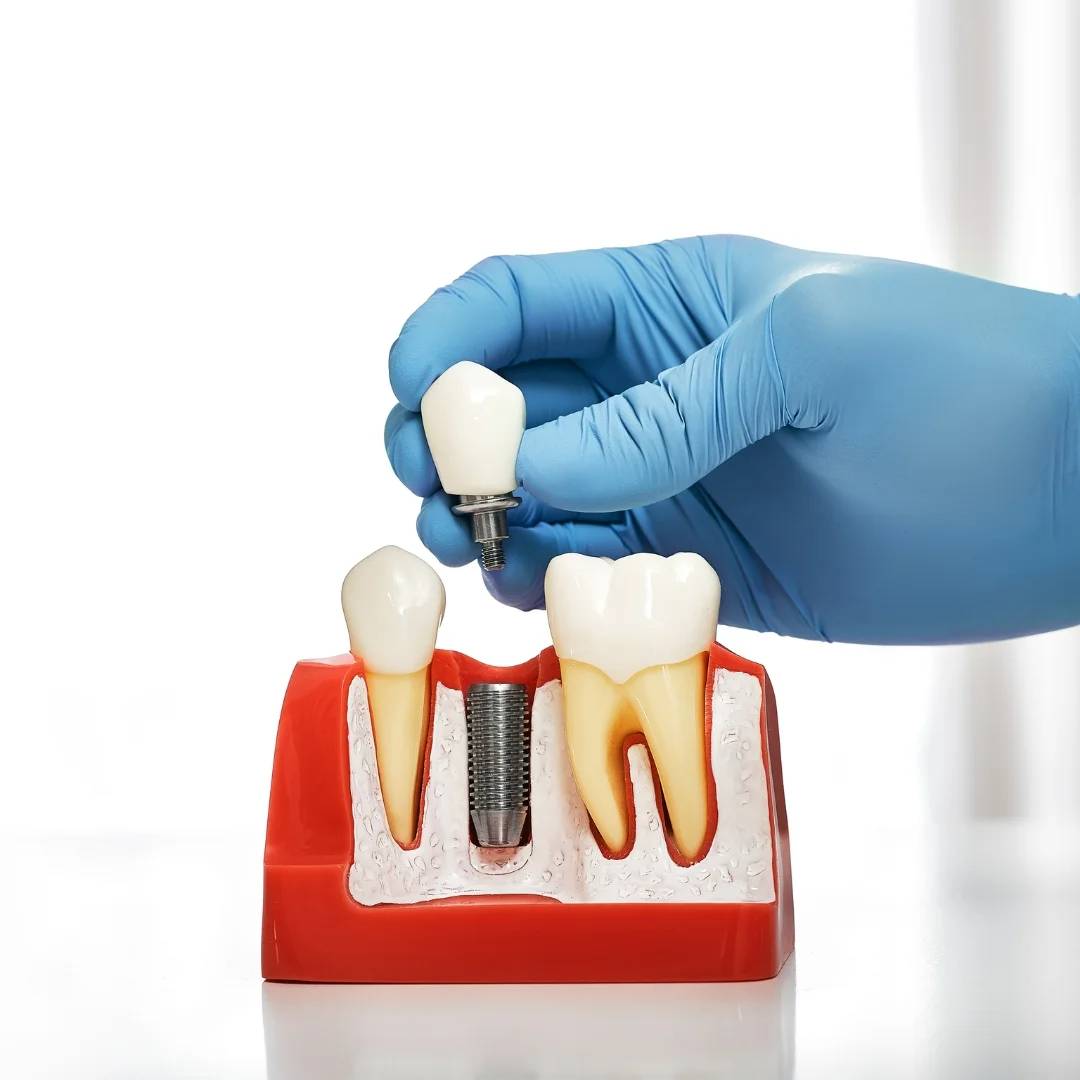
Quick Answer: A dental implant replaces a missing tooth with a small post placed in the jawbone. The post acts as a new root and supports a custom crown. Unlike a bridge, it does not rely on the neighbouring teeth, and unlike a partial denture, it stays fixed in place. For many adults with healthy gums and enough bone, dental implants in Strathroy are the closest thing to getting the original tooth back.
Losing one tooth can feel like a small problem until you notice how often your tongue finds the gap. If you are researching dental implants in Strathroy, you probably want two plain answers: how the treatment actually works, and whether it beats a bridge or a partial denture for your situation. At Burns Family Dental on Burns Street, we walk patients through those exact questions every week. This guide gives you the same explanation we give in the chair.
How Does a Dental Implant Replace a Missing Tooth?
An implant replaces both the visible tooth and the root beneath it. Most other options only replace the part you can see. That difference explains most of the benefits, and also most of the planning involved.
A complete single-tooth implant has three parts. First, the implant itself is a small post, usually titanium, that sits in the jawbone. Next, an abutment connects that post to the surface of the gum. Finally, a custom crown is shaped and shaded to match your surrounding teeth. According to the Canadian Dental Association, implants are anchored in the jaw and act as a base for replacement teeth.
Why the root matters
Your jawbone responds to the pressure of chewing. When a tooth root disappears, the bone in that area slowly loses that stimulus and can shrink over time. Because an implant sits inside the bone, it carries chewing forces much like a natural root. As a result, it helps keep the site stable and supports the gum contours around the new crown.
What to Expect From Dental Implants in Strathroy
Treatment happens in stages over several months, with healing time built in between visits. Here is how the process usually unfolds at our office.
1. Assessment and imaging
We start with a full exam, a look at your gum health and digital X-rays of the area. Specifically, we want to know how much bone is available and where important structures sit. If gum disease is present, we treat it first, since healthy tissue gives an implant its best foundation.
2. Preparing the site
Sometimes the damaged tooth is still in place and needs a gentle extraction. In other cases, the tooth has been missing for years and the bone has thinned. Bone grafting can rebuild that area so the implant has enough support. Research on implant positioning notes that bone and soft tissue deficiencies are two of the main factors affecting the final appearance, which is why we plan this step carefully.
3. Placing the implant
Placement is done under local anaesthetic, so the area is fully numb. For patients who feel anxious, we also offer nitrous oxide sedation to help you relax. Afterward, most people describe the soreness as manageable with simple over-the-counter pain relief.
4. Healing and the final crown
Over the following weeks and months, the bone bonds with the implant surface. Once the site is stable, we attach the abutment and fit your permanent crown. Timing varies, however. A systematic review on loading protocols for single-implant crowns compared immediate, early and conventional loading, so your dentist will choose the timeline that suits your bone and bite.
Implant, Bridge or Partial Denture: Which Is Better?
An implant is often the strongest long-term choice for a single missing tooth, but it is not automatically the right choice for everyone. Each option has a real place.
The traditional bridge
A bridge fills the gap with a false tooth held by crowns on the teeth on either side. The Canadian Dental Association’s page on bridges explains that those neighbouring teeth act as anchors. Consequently, they need to be reshaped, even if they are perfectly healthy. On the other hand, a bridge is usually faster to complete and requires no surgery. If the adjacent teeth already need crowns, a bridge can make a lot of sense.
The partial denture
A removable partial denture is the most affordable way to restore the gap. It clips onto nearby teeth and comes out for cleaning. However, some patients find it less stable when chewing. It also does not replace the root, so it does little to preserve the bone beneath.
The implant
An implant stands on its own. Nobody needs to file down your neighbouring teeth, and you brush and floss it much like a natural tooth. Additionally, a systematic review in Clinical Oral Implants Research assessed the five-year survival of implant-supported single crowns and tracked their biological, technical and aesthetic complications. That kind of long-term data is a big reason implants have become a standard option. The trade-offs are a higher upfront cost, a longer treatment timeline and a minor surgical step.
Who Is a Good Candidate for a Single-Tooth Implant?
Good candidates generally have healthy gums, enough jawbone (or the ability to rebuild it) and good overall health. Smoking, uncontrolled diabetes and active gum disease can all affect healing. Still, these factors rarely rule you out entirely. Instead, they shape the plan.
Age on its own is rarely the deciding factor for adults. What matters more is a fully developed jaw, stable general health and a willingness to keep up with home care and regular checkups. In fact, the habits that protect your natural teeth also protect an implant.
Caring for Your Implant After Treatment
Implants cannot decay, but the gums around them can still become inflamed. Therefore, daily brushing, cleaning between teeth and professional cleanings stay essential. If you grind your teeth at night, a night guard can also protect the new crown from excess force. During your regular visits, we check the implant, the crown and the surrounding tissue so we can catch small issues early.
Planning Dental Implants in Strathroy With Our Team
Burns Family Dental offers restorative, surgical and sedation care under one roof at 352 Burns St. That means your assessment, any extraction or bone grafting, and your final crown can all happen in a familiar setting. You can learn more on our dental implants page. We also accept the Canadian Dental Care Plan, and our front desk team can help you understand what your insurance or CDCP eligibility may cover before you commit to anything.
Ready to find out whether an implant, a bridge or a partial denture fits your smile best? Contact Burns Family Dental to book a consultation. We will look at your X-rays with you, explain every option and give you a clear plan with honest timelines.
Frequently Asked Questions
Does getting a dental implant hurt?
The area is fully numbed during placement, so most patients feel pressure rather than pain. Afterward, mild soreness for a few days is common. Nitrous oxide sedation is also available for nervous patients.
How long does the whole implant process take?
It often takes several months from start to finish. Healing time varies, and it gets longer if you need an extraction or bone grafting first. Your dentist will give you a personal timeline after your assessment.
Is an implant better than a bridge for one missing tooth?
Often, yes, because an implant does not require reshaping the neighbouring teeth and helps support the jawbone. However, a bridge can be a sensible choice when the adjacent teeth already need crowns or when surgery is not suitable.
Can I get an implant if a tooth has been missing for years?
In many cases, yes. If the bone has thinned, bone grafting can rebuild the site before the implant is placed. An exam and X-rays will show what your jaw can support.
Sources & References
- Canadian Dental Association: Dental Implants
- Canadian Dental Association: Bridges
- Loading protocols for single-implant crowns: a systematic review and meta-analysis
- Systematic review of the survival rate and the incidence of complications of single crowns on implants with a mean follow-up of 5 years